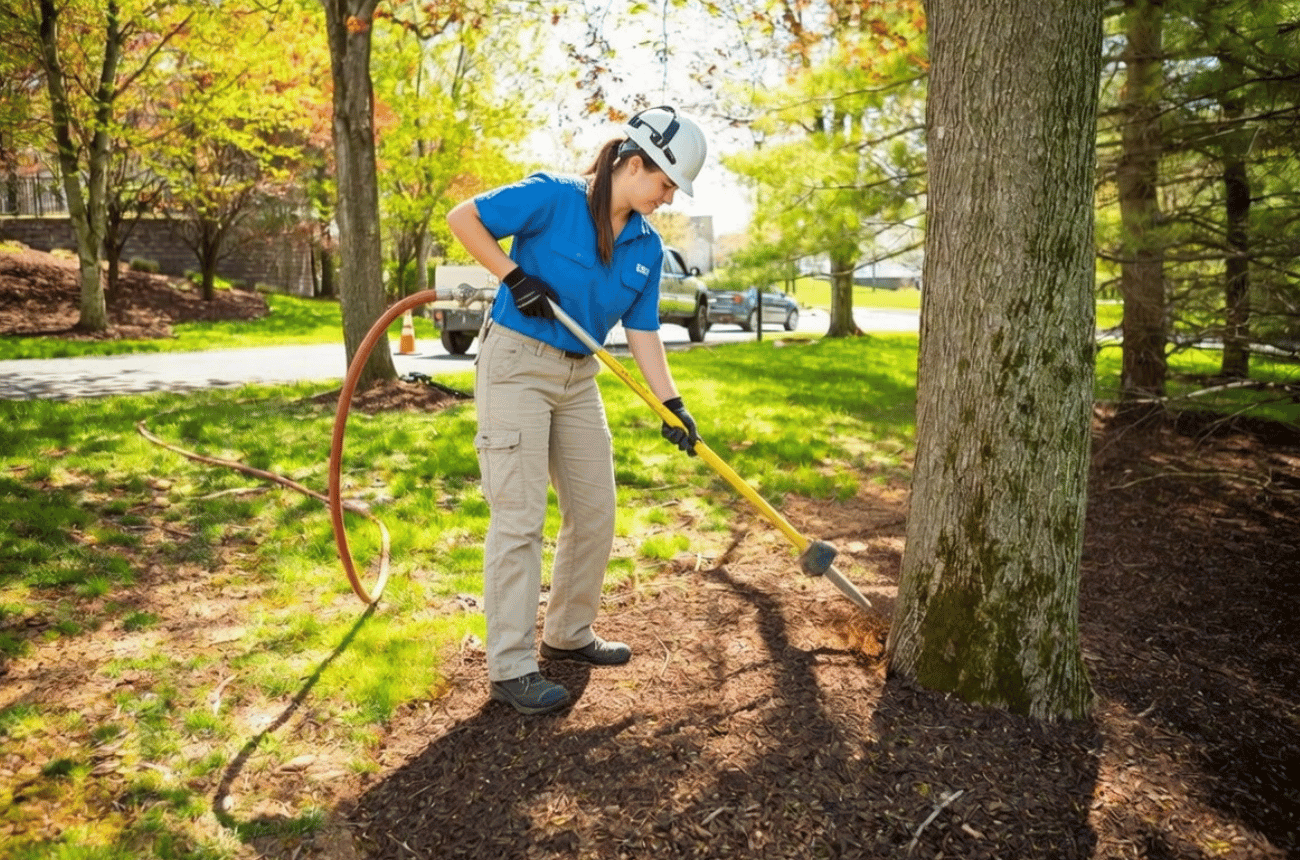
Traditional digging destroys roots; our advanced pneumatic technology uses high-velocity air to safely uncover and treat your tree’s foundation without causing a single scratch.
Many tree health crises are "underground" problems manifesting in the canopy. If your trees are displaying these symptoms, they likely need an Air Spade intervention:
At Eugene Tree Health Care, we utilize the industry-leading Air-Spade® tool to perform surgical-level work in the most sensitive area of your tree: the Root Flare.
We safely remove excess soil and mulch that has accumulated against the trunk. This exposes the "trunk flare," preventing moisture-induced decay and allowing the tree to breathe as nature intended.
Once the roots are exposed via Air Spading, we identify and selectively prune roots that are choking the trunk. This restores the tree's vascular health and extends its lifespan by decades.
We "blast" channels of air into compacted soil, breaking up hard-pan clay. We then backfill these channels with organic matter, creating high-speed "nutrient highways" for new root growth.
Planning a new fence or patio? We can map the exact location of structural roots using air, allowing you to design your hardscape around the tree rather than through it.
Our workflow is designed to provide maximum data and health benefits with zero mechanical impact on your trees.
The Deliverable: Each service includes a Root Architecture Report, featuring "before and after" photos of the root flare and a detailed map of any structural corrections made.
Soil compaction is the #1 killer of urban trees in Oregon. We have the specialized tools and the biological expertise to fix it.
In Eugene, our heavy clay soils—often referred to as "Eugene Silt"—are prone to severe compaction that traditional aeration can't fix. Eugene Tree Health Care understands the delicate balance required to treat our native Douglas-firs and Oregon White Oaks. We know how these species respond to root exposure in our specific climate, ensuring that every Air Spading project is timed perfectly to match the tree's natural growth and recovery cycles.
Not at all. The air pressure is calibrated to move soil particles but flows harmlessly around the flexible, solid structure of the roots. It is the safest way to "dig" around a tree.
Most root flare excavations or radial trenching projects take between 2 and 4 hours per tree, depending on soil type and the diameter of the trunk.
We use specialized ballistic blankets and vertical shielding to contain the soil. While some dust is inevitable, we pride ourselves on leaving your property as clean as we found it.
While we can work in damp soil, we avoid Air Spading in heavy rain or saturated conditions, as the soil becomes too heavy to move efficiently with air. Spring and Fall are ideal "Air Spading seasons" in Eugene.
Yes. Lawn spikes only compress the soil further to the sides. Air Spading actually removes the compaction by shattering the soil structure and introducing permanent pore space for oxygen.
In most cases, we incorporate the loosened soil back into the site, enriched with organic amendments. If there is excess soil, we can relocate it to other areas of your landscape or haul it away.