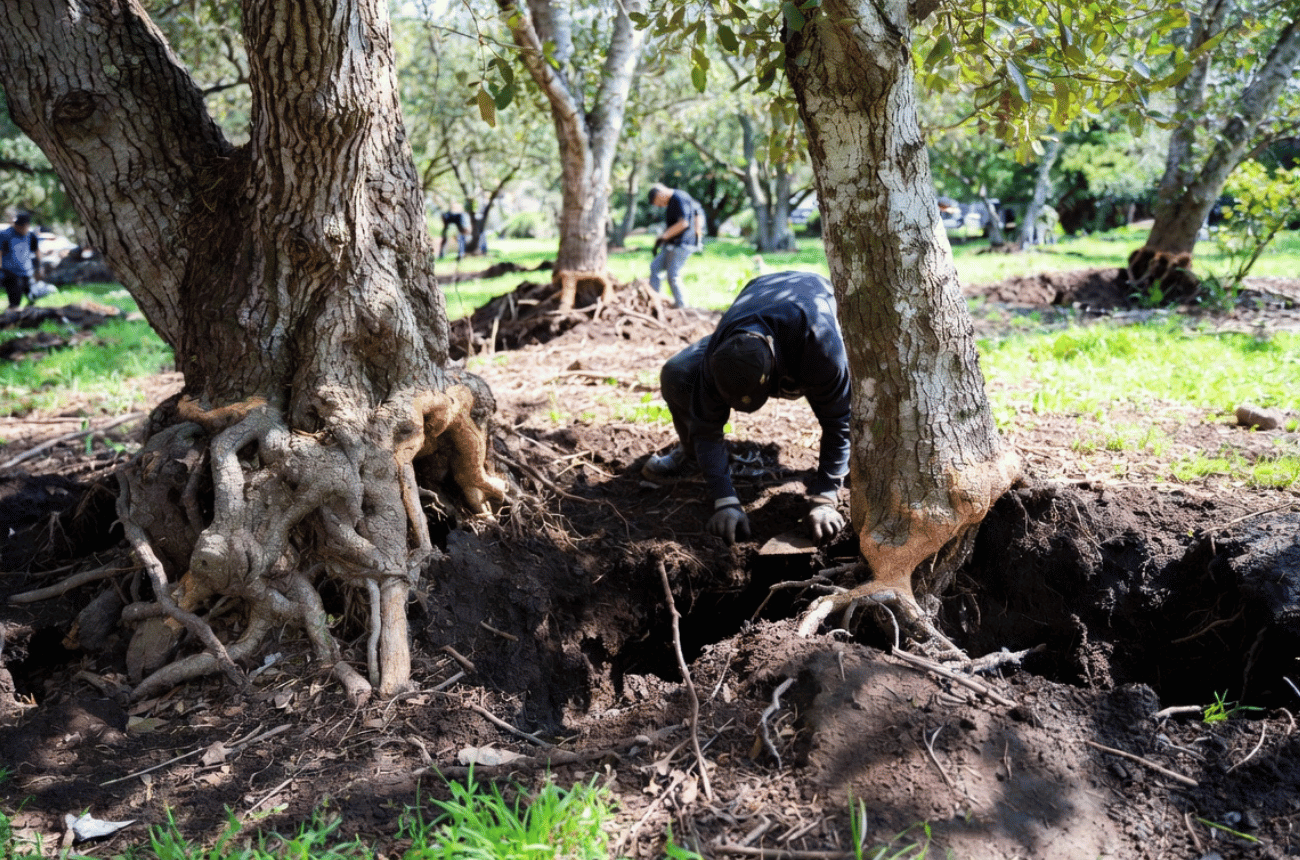
Most tree decline starts with a buried root collar. By uncovering the "flare," we stop stem-girdling roots and bark decay before they lead to a total—and avoidable—tree failure.
A tree should flare out where it meets the ground. If your tree looks like a telephone pole stuck straight into the earth, it is likely buried too deep. This "hidden" stressor leads to several fatal symptoms:
At Eugene Tree Health Care, we use specialized tools to perform delicate "surgery" at the base of your tree, ensuring the trunk stays dry and the roots stay healthy.
We use high-velocity compressed air to safely blow away excess soil and mulch. This non-destructive method leaves the delicate root bark 100% intact while revealing the true structure of the root collar.
Once the flare is exposed, we identify "choker" roots that are crossing or circling the trunk. We expertly prune these roots to restore proper sap flow and prevent future structural snapping.
"Mulch volcanoes" are a primary cause of root collar rot. We remove the excess material and re-establish a "doughnut" mulch pattern that protects the soil while keeping the trunk clear of moisture.
With the root collar visible, we inspect for signs of Armillaria (Shoestring Root Rot) or Phytophthora. Identifying these early allows us to treat the infection before it reaches the heartwood.
Our process is clinical and clean, focused on long-term biological recovery.
The Deliverable: You receive a Basal Health Audit, including "before and after" photos of the excavated flare and a summary of any structural root corrections performed.
Buried root collars are a widespread issue in Eugene due to decades of improper planting and heavy "mulch volcano" trends. We are here to fix it.
In the Willamette Valley, our high moisture levels mean that a buried root collar is a death sentence for species like the Japanese Maple or the native Oregon White Oak. At Eugene Tree Health Care, we understand how our local soils hold moisture against the bark. We’ve saved hundreds of Eugene’s heritage trees simply by letting their trunks breathe again. We combine scientific precision with a deep respect for the Pacific Northwest landscape.
It usually happens during original planting (planting too deep), over-mulching over several years, or from soil runoff during heavy Eugene rainstorms.
Yes, it is powered by a large air compressor. While the process is loud, it is relatively quick, and we always work during respectful daytime hours to minimize neighbor disturbance.
No. We are only removing "fill" soil or mulch that shouldn't have been there. We do not remove the structural soil that holds the tree in place.
For a medium-sized tree, the process takes about 2 to 3 hours. Larger, older trees with complex root systems may take a bit longer.
If a girdling root has become a major structural component, we may "bridge" it or perform a partial notch to relieve pressure. Our arborists make these calls based on the tree's overall stability.
Yes! In fact, the dormant season is a great time for root work in Oregon. As long as the ground isn't a "swamp" of standing water, we can effectively use the Air-Spade.